
Fixing Bikes
and other broken things

It’s a muggy Saturday morning in D.C. References to this place as a swamp are not all metaphorical. I roll up to the dingy-looking hardware store parking lot and find a place to lock my bike in a jumble of pallets and stacks of Quikrete. Unlike so many places I’ve lived before where things sprawl out, function is all jammed on top of itself in cities. Here there are no separate loading docks and parking lots.
I start setting up the pop-up tents and workbenches. The sounds of a peewee football game drift from across the street. Emphatic cheers and whistles narrate as gaggles of kids in color-coded pads and helmets chase each other like bobble heads across the field. I hang the banner in the tent closest to the street and complete the transformation from parking lot to ragtag bike clinic. The Bike House is open.
You bring your broken bike and your curiosity, we bring the tools and the know-how. Hopefully, you leave with a less broken bike and the new confidence of knowing that you just fixed the thing yourself. We educate, we provide moral support - mostly we just demystify - bikes are pretty simple machines after all.
A typical mix of folks has shown up after an hour. Tire change tutorials run on an endless loop. A few brave folks are diving deeper in; there is a drivetrain tune-up going on in one stand, brake re-cabling and adjustment in another. The mysteries of limit screws and cable tension evaporating on contact with explanation, “oh, so it’s just a spring in there?”
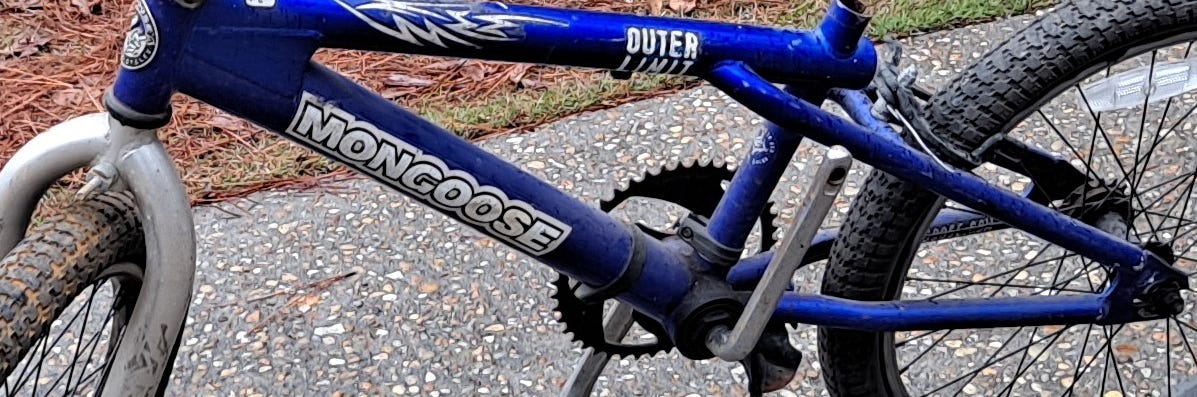
I feel a tap on my arm and turn to see a kid of about 10 looking up at me. Too big hand-me-down tennis shoes, holes in the knees of his jeans grass-stains on his oversize t-shirt tell of many an adventure. “Mister, can you fix my bike?” he says, extending me the handlebars of a blue Mongoose. Not quite a BMX bike, not quite something else. This is the kind of bike you’d buy at a big box store, and it was probably his first ‘big kid bike’. It probably didn't come with training wheels, and it definitely didn’t come designed to be repaired. I glimpse our new customer’s buddy standing out at the edge of the pop-up tents, his matching grass-stained uniform marking him as a fellow neighborhood adventurer.
I take the handlebars in hand and simply tilting the bike for a better look produces a nasty sounding clunk. “Sometimes when I pedal, the chain won't work…” he says to me expectantly, one hand gesturing in the direction of the back wheel and the other tangled up in the hem of his t-shirt. He bounces and sways, exuding the raw energy that kids of his age do. Physical manifestations of feelings unconstrained by the social norms that calcify around us as we grow up. I look at the back wheel and the obvious source of the klunk. The bearings that ought to be holding the back wheel in place are gone. Not metaphorically gone, just fell out and not there gone. The steel axle of the wheel is floating loose in the hub and I can move the back wheel 2 inches from side to side. I’m shocked this thing has been working at all. This is buy new parts, probably buy a new bike type broke. This is your beloved 200k mile Subaru Outback blew-a-head-gasket broke. “So, can you fix it?” he asks. This time his expectant look exposes where the tooth fairy has recently robbed him.
As I realize how broken this bike is and try to figure out how I’m going to answer, I’m transported to my own childhood. My bike was such an integral part of my life at that age. Freedom, transportation - all the independence I had was tangled up with my bike. I rode to my best friend Nick’s house down 11th street, or across the railroad tracks to Ray Toledo's house. We biked to the park and to the river to fish and catch garter snakes. We biked to the basketball court to shoot hoops and to the IGA to buy grapefruit SoBe with paper route money. We biked to the vacant lot where we played baseball with ‘ghost runners’ till Norma, the mean old lady who lived behind the lot, came out and yelled to chase us away. We had holes in the knees of our jeans and grass stains on our shirts. These are all fond memories, but in this moment the flood of nostalgia brings dread. I’m a good mechanic, but I really don't think this thing can be fixed.
I get down on one knee to start delivering the bad news. “Hey buddy, so this thing is broken pretty bad.” It’s not sinking in yet, his look is still hopeful as he fiddles with a screwdriver he has picked up off the workbench. “Do you live close enough that you can carry your bike home? If I take that wheel off, I’m not sure that I’ll be able to get it back on, so you might have to carry it home with no wheel.” The practicality of this starts to hit him, I see the cloud of realization start to darken his expectant look. The bell has been rung, and I press with the question that now has such existential weight “If you want, I can try to fix it, but I probably won't be able to… and if I take it apart, I may not be able to put it back together. Do you want to keep riding it like it is, or do you want me to take it apart and try?”
He quietly considers. Realization has fully eclipsed any expectant hope on his milk and ketchup mustachioed face. He stands notably still. His look is now one of concern, not quite mourning yet, but this is a weighty decision for a 10ish-year-old. I'm sure the prospect of a new bike after this one is anything but certain.
“Do It…” He delivers the decision with all the solemn concision it deserves, and we’re committed. I am, of course, now only working on this the rest of the day. We’ve moved from the realm of the mechanical to the realm of the human, I’m not just working on bearings anymore. Everyone else at the clinic, volunteers and customers alike, quickly grasp this situation. The kind anthropology professor I had been helping with a brake adjustment releases me with a glance and a nod. There is a higher priority now, and we’re all in the common cause of restoring the freedom of our carefree adventurer.
Recently, when I’m not working on bikes, I’ve been in a kind of stunned haze. A lot has changed for me since the election last year. Questions about whether I’ll lose my 15-year career have been hanging over my head every day. Will I get fired? Will I get asked to do something I can’t do with integrity? These questions are more in my face some days than others, but always there. Some days it's just a nagging and unspoken feeling, and some days I get told to make a prioritized list of who I would fire while I wonder if I'm on the same list my boss was asked to make. Harder than wrestling with these questions myself is trying to answer them for my employees. Not having answers to give your team when they are wondering about their livelihood is not a comfortable place to sit. These questions are never really just about work, they are about self-worth and identity and mortgage payments.
I think part of the numbness I’ve felt has been a hesitance to complain. The fact that I’m so rattled by uncertainty in my job may only be evidence of how lucky I have been so far to be insulated from realities that are all too common. I certainly don't want to be a complainer, but there is more to this numbness than just introspection on how lucky I’ve been. I work for the government, and I’ve always taken deep pride in that fact. I’ve passed up a lot of money over the years to keep that badge of pride. I have the unfortunate condition of being an idealist, and it’s not subtle. I cry reliably in about half the episodes of The West Wing. Maybe the stronger evidence is that I’ve watched the West Wing enough times to know this result replicates. Idealism is often a two-edged sword, but it has felt much more curse than blessing recently. How could so many of my fellow Americans want this? Disappearing people to a foreign gulag without process, abandoning allies in the middle of a fight, chilling speech and banning books. These are all the things that the bad guys do, and I’ve always thought we were the good guys. I've always thought we at least wanted to be the good guys. I don't know from day to day if I’ll be fired, but more deeply unsettling is that I no longer know if I can take pride in my role.
During the campaign in 2024, I often thought about how I might feel if things turned out the way they did. I expected to feel feelings that were active and energetic and driving. Righteous indignation, resolve, renewed commitment to the values that made me care about this in the first place. Reality has been nothing like that. In reality everything I’ve felt has been colored with quiet, withdrawal, and self-doubt. What did I miss? What am I not seeing or hearing? Why do so many people I love want this? Why can they not see it for what it is? Is this actually who we are? Was this how my conservative friends and family felt when Biden was elected? How about Obama? Can they really not see how different this is?
Stunned, numb, scared to lose my job, scared for the future of the folks who I work with and who work for me. Feeling distance between myself and my fellow Americans who seem to be shunning things I thought we all held dear. Feeling separate from my friends and family who seem not to care if we’re the good guys or the villains.
It took about two hours, including two people arduously balancing tiny ball bearings individually in place with grease and tweezers. Doubt overhung the whole proceeding, I didn't know if it would actually roll until we got the whole thing put back together. We finished by explaining “Righty Tighty, Lefty Loosey” and having our neighborhood explorer reinstall the sweet pegs on his Mongoose all by himself.
“It’s fixed! Thank you!” he yelled with a grin over his shoulder as he rode away. His buddy, who’d learned how to pump up his tires by himself during the bearing surgery, was in hot pursuit.
We’d done it. In our little rag-tag clinic in a parking lot, we’d restored the freedom of a kid to learn, to roam, to rip more holes in his jeans and to explore. Something all of us there connected to in our own way, a shared value that we all cared for, was rescued and restored with patience, cooperation, sweat and greasy hands.
In the midst of my stunned introspection about what’s happening in the world, my weekends at the bike clinic now feel like they contain some important truth. Maybe helping our neighbors fix their bikes is how we remind ourselves we have more in common than what divides us, and maybe that’s the key to how we fix our country. Maybe that hope is just my idealism breaking through and grasping. Maybe the truth is as simple as the fact that getting out and talking to people while you help someone feels good, and we should do more of it.
We will fight to save this
We will fight to keep it alive
This is a cause worth fighting for
We will rescue & restore
Creative Captivity - August Burns Red
Beautiful writing. Thanks for being you.
Thank you for sharing this very thoughtful piece. You have a gift for storytelling. Some days I struggle to be hopeful about the future, but today is not one of them. Thanks for being the light.